
Solution · Online grocery
Meta Ads for online grocery stores
RankNexus runs Meta Ads for online grocery stores. For WB Groceries, a grocery retailer in the United States, monthly purchase value rose 7.6 times, from $7,972.11 to $60,545.55, on 8.2 times the spend, February 2025 against July 2024 (Meta Ads Manager). It scaled at a slightly lower return: ROAS went from 2.30 to 2.13. Purchase value is not total revenue.
From $1,500/month. Ad spend is paid directly to Meta from your own account.
Reviewed by M. NoumanCo-founder, RankNexus · Updated 14 November 2026
- What we do
- Meta Ads for online grocery stores
- For stores whose customers order on their own website.
- One result, with its limits
- 7.6x the purchase value
- WB Groceries, February 2025 against July 2024 (Meta Ads Manager), on 8.2x the spend. ROAS 2.30 to 2.13.
- Price
- From $1,500 a month
- Plus your ad spend, paid directly to Meta.
- What we don't promise
- Sales, a ROAS or profit
- One client's result is not a forecast for yours.
01 / Owner questions
What do online grocery store owners ask before running Meta Ads?
Before Meta Ads, an online grocery store needs three answers: will the ads bring orders, what return does our margin need, and will that return hold as spend grows. In our one grocery account, ROAS went from 2.30 to 2.13 while monthly spend grew 8.2 times.
Online grocery marketing on Meta comes down to those three answers. Meta showed ROAS of 2.30 in July 2024 and 2.13 in February 2025, both above 2. The record shows those two months only.
The table is built from questions owners commonly raise, not from client data.
| Owner question | The short answer | Where on this page |
|---|---|---|
| Will Meta ads bring orders, or just likes? | Choose Sales as the campaign objective, and Meta aims at purchases on your website, once your site reports them. | 03, catalogs and Advantage+ |
| What return do we need? | The break-even ROAS your margin needs. Work it out before you set a budget. | 06, what it costs |
| How much should we spend? | Once we've reviewed your offer, we agree a starting budget with you, before any ad goes live. | 06, what it costs |
| Can we grow monthly sales and keep ROAS above 2? | Nobody can promise a ROAS. Our one grocery account showed 2.30 in July 2024 and 2.13 in February 2025, as monthly spend grew 8.2 times; the months between aren't in the record. | 05, what the account did |
| What happens to an ad when an item sells out? | In a catalog, items marked "out of stock" don't show in ads. | 03, catalogs and Advantage+ |
02 / Where Meta fits
Which channels fit an online grocery store, and where does Meta fit?
Meta Ads suits online grocery stores that sell through their own website and want new shoppers in the areas they serve, plus repeat orders from past visitors. Shoppers already searching for groceries online are reached with Google Search and Shopping, which RankNexus also runs.
Meta Ads fits when customers can order on your website, you can fill more orders, and Meta can see each purchase. Our grocery result counts online purchases only. The table shows how we judge fit; it isn't measured data.
| Channel | Who it reaches | When it fits a grocery store | Run by RankNexus? |
|---|---|---|---|
| Meta Ads (Facebook, Instagram) | People in the areas you serve who don't know your store yet; past visitors and customers, through retargeting | Customers order on your website, you can fill more orders, and your site reports purchases to Meta | Yes |
| Google Ads: Search, Shopping, Performance Max | People already searching for a grocery item or store online | You have a Merchant Center feed, and people search for what you stock | Yes |
| Email and text messages | People who already buy from you | Reorders and weekly deals | No: they stay yours. With your permission, and where consent allows, we use the customer list to build audiences |
| Delivery apps, flyers and in-store offers | Shoppers inside those apps, or in your store | You already use them | No: they stay yours. Our grocery result counts online purchases, not store visits |
03 / Catalogs and Advantage+
Do you need a product catalog and Advantage+ to sell groceries on Meta?
To run catalog ads on Meta, an online grocery store needs a product catalog: every product with an id, title, description, availability, condition, price, link and image. Meta doesn't show out-of-stock items in ads, so the catalog has to keep up with your shelves.
Meta's Catalog Fields page also asks for a brand, gtin or mpn (the image goes in image_link). Availability is "in stock" or "out of stock", and out-of-stock items "don't display at all in your ads".
Meta's guide to Advantage+ catalog ads starts with a catalog, "such as a product catalog available in your Meta Business Suite account", and each ad set promotes one product set: for a grocery store, perhaps one aisle or this week's deals.
Meta has "updated and renamed Advantage+ shopping to Advantage+ sales campaigns", which it says "drive sales by optimizing across creative, targeting, placements, budget and destination". You choose Sales, then a conversion location (Website, Website and app, or Website and shop, US only), and may need a Pixel, an app or a Commerce account. Our Essentials plan tests Advantage+ against your goal where it fits.
On the WB Groceries account we simplified the campaign structure around the strongest product categories, the job product sets do in catalog ads. The record doesn't show which campaign types ran, so we claim neither catalog ads nor Advantage+ for that result.
| Field | Fictional example | Why it matters for a grocery store |
|---|---|---|
| id | OATS-32 | Your own product code |
| title | Rolled oats, 32 oz | Say what it is, and its size |
| availability | in stock | Items marked "out of stock" don't show in ads |
| price | 5.49 USD | A number, a space, then the currency code |
| sale_price | 4.49 USD | Must be less than the full price |
| sale_price_effective_date | This week's deal dates | Without it, the deal runs until you remove it |
| link, image_link | The product page and its photo | Where the ad sends people, and what it shows |
A practical tip: Put weekly deals in the catalog as a sale price with its dates. Meta's rules: the sale price "must be less than the full price", and without sale_price_effective_date, items with a sale price "remain on sale until you remove their sale price".
Meta's own pages, read on 14 November 2026 (none shows a date)
04 / Weeks one to four
What we do in the first 30 days for a grocery store
In the first 30 days we audit and clean up your ad account, agree the return your margin needs, check that Meta sees every order and its value, build ads around your strongest product categories, and launch once Meta's ad review allows.
The steps come from the first month of our Essentials plan. Launch comes once access, assets and Meta's ad review allow, typically within the first 30 days; after that, budget rises step by step, and only while purchases follow.
| Week | What we do | What we need from you |
|---|---|---|
| Week 1 | We join your ad account as a partner, audit it and clean it up, then set the target with you: the return each category's margin needs | Access; your margins by category; the areas you deliver to |
| Week 2 | Your 90-day roadmap in writing, within seven business days of a complete start; then a check that each online order, and its value, reaches Meta | Website access |
| Week 3 | Ads from the photos you approve: two creative concepts and their first variants, showing products, deals and delivery; campaigns around your strongest categories; ads that bring back people who visited your site | Photos, this month's deals, approval of each ad |
| Week 4 | Ads go live when Meta's review approves them; we check the account at least twice a week and raise the budget step by step, only while purchases follow | Quick stock and price updates; a note on any order problems |
05 / What the account did
One grocery result, and what it shows
For WB Groceries, a grocery retailer in the United States, Meta purchase value rose from $7,972.11 in July 2024 to $60,545.55 in February 2025, while ad spend rose from $3,458.88 to $28,363.79 (Meta Ads Manager). ROAS went from 2.30 to 2.13: the account scaled at a slightly lower return.
- Monthly purchase value
- $7,972.11 to $60,545.55
- 7.6x (60,545.55 / 7,972.11 = 7.59)
- Monthly ad spend
- $3,458.88 to $28,363.79
- 8.2x (28,363.79 / 3,458.88 = 8.20)
- Purchase ROAS
- 2.30 to 2.13
- As Meta shows them: 7.4% lower, worked out from the two.
- Source
- Meta Ads Manager
- The client's own account: July 2024 and February 2025, two single months.
Monthly ad spend
Monthly purchase value
Purchase ROAS
Meta Ads Manager, client account: July 2024 and February 2025. Purchase value, not total revenue.
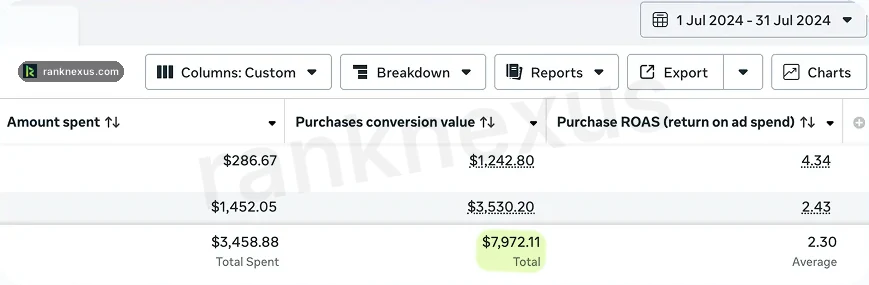
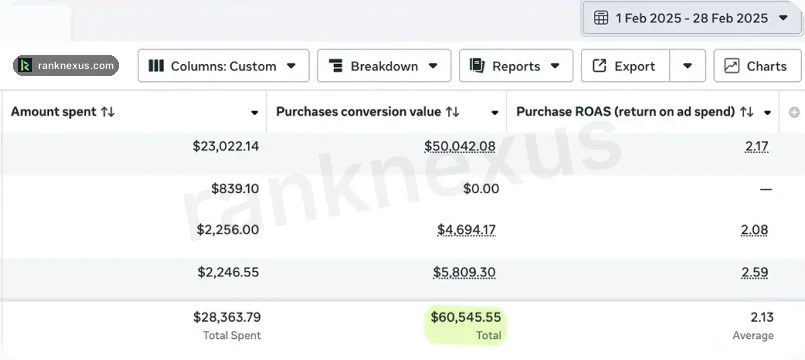
- Purchase value is what Meta attributes to the ads, not the store's total revenue.
- ROAS was slightly lower at the larger scale (2.30 to 2.13); profit depends on margins not shown here.
- One line in the February table spent $839.10 with no purchase value recorded ($0.00).
- The July screenshot shows the first two rows of the July table; its total row covers all of them.
- This is one client's result over the dates shown, not a forecast or a typical result for another business.
It was nice having a team that could handle the online side without us having to worry about every small thing. Whenever we needed an update or had a question, they responded quickly.
06 / What it costs
What does Meta Ads for an online grocery store cost?
Meta Ads management for an online grocery store starts at $1,500 a month on RankNexus's Essentials plan. Ad spend is separate and paid directly to Meta from your own account.
On Essentials (Meta or Google Ads), from $1,500 a month, month one audits and rebuilds your ad account. Each month then brings two creative concepts and up to six ad variants, built on your products, deals and delivery. Advantage+ is tested where it fits, we check that Meta records each purchase, we look at the account at least twice a week, and a 30-minute review closes each month.
Growth from $2,500 adds SEO and AI search, a campaign landing page and weekly updates. Scale from $5,500 runs both ad platforms, with four creative concepts and up to twelve variants a month: the plan that runs Google Shopping beside Meta. Filming, creator content, CRM integrations and server-side attribution builds are quoted separately. We agree a starting ad budget with you after reviewing your offer.
A practical tip: Plan with your own margin, not another store's ROAS. WB Groceries' February 2025 ROAS was 2.13 (Meta Ads Manager); whether 2.13 is enough depends on margins, which the record doesn't show. The free ROAS Calculator shows the ROAS your margin needs.
07 / What the record can't show
What one grocery result can't tell you
One grocery account's result is not a forecast for your store. WB Groceries' figures are two months of purchase value as Meta counts it, not total revenue or profit, so a grocery store should judge Meta Ads against its own sales and margins.
Your result depends on what you sell, your prices and margins, the areas you serve, your photos and deals, your season, and how easily visitors can order. The record doesn't show total revenue, profit, margins, orders, new or returning customers, the months between, or which campaign types ran. We can't promise sales, a ROAS, profit or the same result.
Hold off on Meta Ads for now if:
- Customers can't order on your website.
- Meta can't see purchases, because no Pixel or Conversions API sends them.
- You can't keep stock and prices current in a catalog.
- You don't know your margin by category.
- You can't fill more orders: delivery slots, staff or stock.
A myth about a falling ROAS
- Myth: If ROAS goes down, the ads got worse.
- Fact: At WB Groceries, ROAS went from 2.30 to 2.13 while monthly purchase value grew 7.6 times on 8.2 times the spend (Meta Ads Manager). Whether that meant more profit depends on margins the record doesn't show.
Questions
Online grocery marketing questions, answered.
How do you market a grocery store?
For a grocery store that sells online, give each channel one job: Meta Ads find new shoppers in the areas you serve and bring back past visitors, Google Search and Shopping reach people already searching, and email and texts bring reorders. Track every online order, and judge each channel against your own sales and margins.
How much do grocery stores spend on marketing?
It varies by store, and we don't quote an industry average we can't source. For WB Groceries, monthly Meta spend was $3,458.88 in July 2024 and $28,363.79 in February 2025 (Meta Ads Manager). With us, management starts at $1,500 a month, and we agree a starting ad budget with you after reviewing your offer.
A useful next conversation
Is your grocery store's Meta account ready to grow?
Ask for a free Meta Ads audit: a recorded review of your current ads, targeting and the path to an order, sent within 2 business days.
Get a free Meta Ads audit